
In Short
-
Choose the right business structure to manage liability, taxes and growth potential.
-
Sole traders face unlimited liability, partnerships share liability and companies offer the most protection.
-
Companies provide flexibility for raising capital and growing, but come with higher compliance requirements.
Tips for Businesses
Selecting the right structure depends on your risk tolerance and long-term goals. If personal asset protection is important, consider a company structure. For simpler operations, a sole trader or partnership might be more suitable, but be mindful of their limitations in terms of liability and growth potential.


When starting a business in New Zealand, choosing the right business structure is crucial. The structure you select will impact your liability, tax obligations and the future growth of your business. This article will examine four key legal factors to consider when selecting the most suitable structure for your needs, whether you operate as a sole trader, a partnership or a company.
1. Legal Liability
Legal liability is a crucial factor to consider when selecting a business structure. It determines the extent to which your assets are at risk in case of legal or financial issues. This will impact your business depending on the structure you choose:
- Sole Trader: As a sole trader, you are personally responsible for all business debts. If your business is facing financial difficulties, creditors can pursue your assets, such as your home or car, to recover outstanding debts. This presents a significant risk.
- Partnership: In a partnership, liability is shared between partners. Each partner is personally liable for the business’ debts and obligations. If one partner fails to meet their liabilities, the others risk being held accountable.
- Company: A company offers the most protection, as shareholders’ liability is typically limited to the amount unpaid on their shares. If personal asset protection is your priority, a company is the safer choice, as it limits personal exposure to business-related risks.
However, company directors must be aware that they can face personal liability if they breach their duties under the Companies Act 1993. These duties include:
- acting in good faith and in the best interests of the company;
- exercising due care and diligence; and
- complying with various other legal obligations set out in the Act.
2. Tax Implications
Tax obligations are another key consideration, as they vary significantly between business structures and can have a major impact on your financial planning. The structure you choose will directly influence your tax obligations. A company may offer tax advantages if your business generates significant income, while a sole trader or partnership may offer simplicity and lower tax complexity.
Sole Trader or Partnership
As a sole trader, business income is considered personal income. You will file taxes on your business profits at your personal tax rate. Similar to sole traders, each partner in a partnership reports their share of the business income on their individual tax returns. The business’ income is divided among the partners and taxed at their individual rates.
While this is straightforward, it can place you in a higher tax bracket as the business grows.
Company
A company is treated as a separate legal entity for tax purposes, paying taxes on its profits at the corporate rate. If profits are distributed to shareholders as dividends, those dividends are taxed separately.
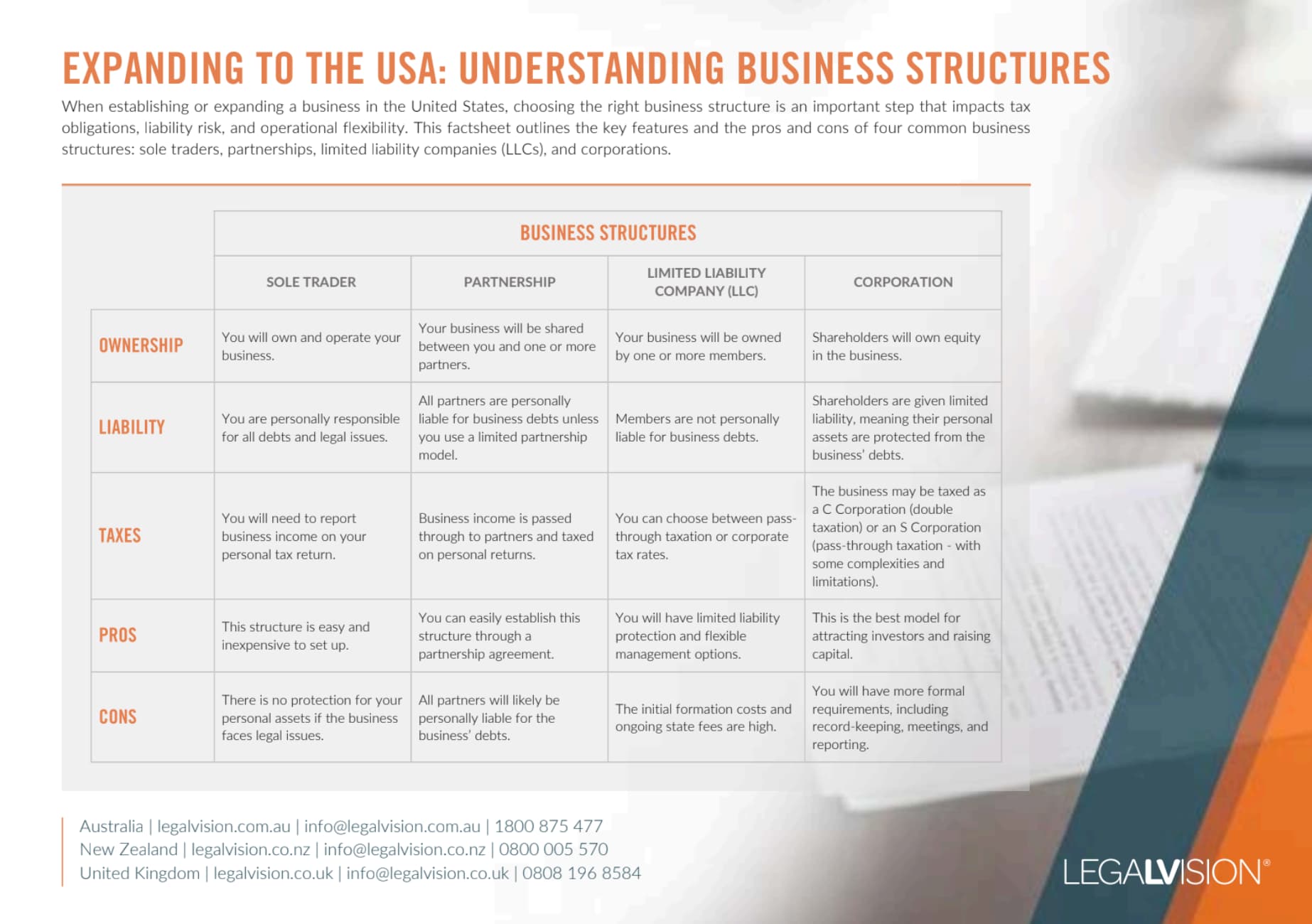
This factsheet outlines the key features and the pros and cons of four common US business structures: sole traders, partnerships, limited liability companies (LLCs), and corporations.
Call 0800 005 570 for urgent assistance.
Otherwise, complete this form, and we will contact you on the same business day.
3. Compliance Requirements
Compliance refers to the legal and regulatory obligations necessary to operate your business. Understanding the compliance requirements of each structure will help you assess the effort needed to maintain your business.
| Sole Trader | Sole traders face minimal compliance requirements. They need to:keep accurate financial records; file an annual tax return; track business income and expenses for tax purposes; and comply with relevant legislation, such as the Fair Trading Act 1986 and Goods and Services Tax Act 1985. |
| Partnership | While partnerships require more formal agreements, such as a partnership agreement outlining the rights and responsibilities of each partner, they still have relatively simple compliance requirements. Record-keeping is essential for tax reporting. |
| Company | Companies have the most extensive compliance requirements under the Companies Act 1993. They must:be registered with the New Zealand Companies Office;maintain up-to-date records; and file annual returns; prepare financial statements and hold annual shareholder meetings (although these requirements are subject to additional criteria and will not be applicable to all companies); pay an upfront name reservation and registration fee; and pay an annual return fee to remain registered. |
4. Exit and Growth Potential
When choosing a business structure, it is crucial to consider both how easily you can exit the business and your ability to grow and scale. The complexity increases depending on your business structure:
- Sole Trader: Exiting or transferring ownership of a sole trader business is challenging because it is not a separate legal entity. You would need to sell assets individually and transfer any contracts. Additionally, raising capital and adding partners is challenging.
- Partnership: Exiting a partnership is a more complex process. It requires agreement from all partners and revisions to the partnership agreement if ownership changes. Attracting new investors is also more challenging than for a company.
- Company: Companies offer greater flexibility. You can sell shares to transfer ownership, and the business can continue under new ownership. LLCs also make it easier to raise capital, bring in new investors and scale the business.
Key Takeaways
Choosing the right business structure is essential for the success of your business. The structure you select impacts your liability, tax obligations, and growth potential:
- sole traders face unlimited personal liability and limited growth potential;
- Partnerships share liability, and both partners must agree on key decisions and changes; and
- companies offer the best protection for personal assets and provide flexibility for growth and transferability.
If you are unsure which business structure best suits your needs, our experienced business lawyers can assist as part of our LegalVision membership. For a low monthly fee, you will have unlimited access to lawyers to answer your questions and draft and review your documents. Call us today on 0800 005 570 or visit our membership page for more information.
Frequently Asked Questions
Can I switch my business structure later if my needs change?
Transitioning between structures (such as sole trader to company) is possible but involves legal and administrative processes. This may include registering a new entity, transferring assets, and updating contracts. There can also be tax implications, so it is essential to obtain both legal and tax advice when making this decision.
How does the choice of business structure affect my ability to raise capital or attract investors?
Different business structures can impact your ability to raise funds. Companies are typically more appealing to investors due to their formal structure and ability to issue shares. Sole traders and partnerships may face greater challenges in attracting outside investment due to their less formal business arrangements and the inability to offer shares in a company. This can limit their options for raising capital compared to companies.
We appreciate your feedback! Request your free consultation now.