


In Short
- Clearly define services, performance standards, and deliverables in your MSA to avoid disputes over scope or quality.
- Review liability, IP, confidentiality, payment, and termination clauses to protect your business and ensure fair risk allocation.
- Professional legal review ensures compliance, up-to-date provisions, and strengthens negotiation outcomes for long-term partnerships.
Tips for Businesses
Take the time to review your Master Service Agreement carefully before signing. Make sure all services, payment terms, performance expectations, IP ownership, and termination rights are clearly outlined. Legal review helps identify risks, update outdated clauses, and enhance negotiation positions, thereby protecting your business while fostering long-term, reliable client relationships.


Master Service Agreements (MSAs) form the backbone of many commercial relationships, especially in professional services, technology, and consulting sectors. These comprehensive contracts establish the framework for ongoing business partnerships, so reviewing them carefully is essential to protect your organisation’s interests. Understanding the key legal issues in MSAs can prevent costly disputes and support smoother business operations. This article outlines the main legal issues in Master Service Agreements and explains how careful review protects your business and strengthens long-term partnerships.
Critical Service Agreement Terms
The foundation of any robust MSA lies in the scope and nature of the business relationship. Therefore, service definitions must be precise and comprehensive, clearly outlining the services to be provided, the performance standards expected, and the deliverable specifications. Otherwise, vague or ambiguous service descriptions often lead to disputes about scope creep or performance failures.
Equally important are the liability and indemnification clauses. These provisions determine who bears responsibility when things go wrong. Specifically, MSAs may include indemnification clauses that protect either or both parties from particular situations, such as third-party claims arising from their respective performance under the agreement. In addition, MSAs may include liability caps to provide certainty for both parties, as well as clear exclusions for such caps. For instance, those related to breaches of confidentiality or intellectual property provisions. Therefore, the parties should carefully review limitation of liability clauses to ensure they do not inadvertently exclude liability for fundamental obligations.
Payment and Performance Clauses
Financial terms within MSAs require careful review to ensure both cash flow protection and fair compensation structures are in place. Consequently, payment schedules should make commercial sense for both parties and align with service delivery milestones. Additionally, late payment provisions, including interest rates and collection costs, should be reasonable while still providing adequate protection and compensation to the service provider.
Similarly, performance standards and key performance indicators (KPIs) must be clearly defined and measurable. Specifically, these metrics should include:
- realistic targets;
- consequences for non-performance;
- and remediation procedures.
Furthermore, service level agreements (SLAs) embedded within MSAs should specify:
- minimum performance thresholds;
- measurement methodologies; and
- appropriate remedies for failures.
Call 0800 005 570 for urgent assistance.
Otherwise, complete this form, and we will contact you on the same business day.
Termination Rights
Termination provisions significantly impact the parties’ ability to exit relationships while protecting their investments. MSAs should distinguish between termination for cause (such as a breach), termination for convenience, and automatic termination triggers. Termination for cause should clearly define what constitutes a breach, remedy periods, and notice requirements.
Notice periods for termination must strike a balance between operational needs and the stability of the relationship. Longer notice periods provide stability but may trap parties in deteriorating relationships, while shorter periods offer flexibility but can disrupt business continuity, especially where there has been significant upfront investment. The appropriate balance depends on the nature of the services, their costs, and market conditions.
Post-termination obligations require careful structuring to ensure smooth transitions. These provisions should address:
- data return or destruction;
- ongoing confidentiality requirements;
- any transition arrangements; and
- continuing obligations.
Survival clauses must specify which provisions remain effective after termination, typically including confidentiality, intellectual property ownership, and limitation of liability provisions.
Intellectual Property Ownership
Intellectual property provisions often represent the most complex and valuable aspects of MSAs. Therefore, clear ownership structures must be established for:
- pre-existing IP;
- newly developed IP; and
- derivative works.
Background IP belonging to each party should be clearly identified and protected, while new IP developed during the relationship requires careful allocation based on the parties’ contributions and strategic objectives.
Additionally, licensing arrangements for any new or existing IP should specify permitted uses, territorial restrictions, and the duration of the rights.
Professional Review Benefits
Engaging legal professionals for MSA review provides substantial strategic and financial benefits. Experienced lawyers can identify potential legal pitfalls that non-lawyers often overlook, including regulatory compliance requirements, enforceability issues, and jurisdiction-specific legal nuances.
In addition, a professional review ensures that contracts align with current legal standards and business practices. Laws evolve continuously, and template agreements may contain outdated or inappropriate provisions. Legal advisors can modernise agreements and incorporate recent legal developments affecting the relevant industry or jurisdiction.
Furthermore, professional review enhances negotiation positioning by identifying areas for improvement and developing strategic approaches to discussions. Understanding the legal implications of various provisions enables more informed business decisions and stronger negotiation outcomes.
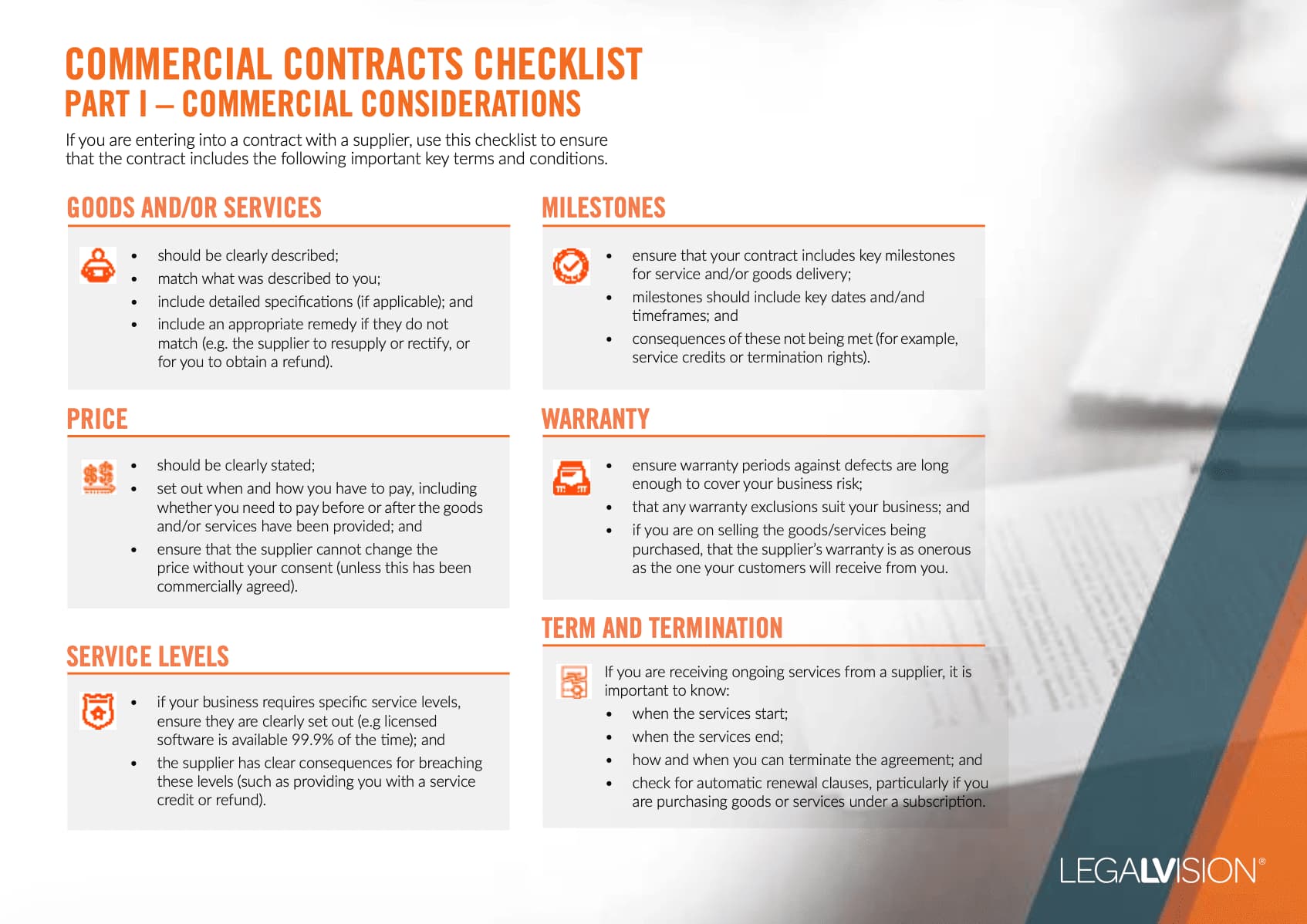
To protect your business, ensure supplier contracts meet your business’ needs. Our free Commercial Contracts Checklist will help.
Key Takeaways
A Master Service Agreement review requires careful attention to these critical legal issues to protect business interests and ensure the success of long-term relationships. Professional legal review provides essential protection against potential disputes and maximises the agreement’s strategic value for all parties involved.
If you need help reviewing your master service agreement, our experienced contract lawyers can assist as part of our LegalVision membership. For a low monthly fee, you will have unlimited access to lawyers to answer your questions and draft and review your documents. Call us today on 0800 005 570 or visit our membership page.
Frequently Asked Questions
What is a Master Service Agreement, and why do I need one?
An MSA is a comprehensive contract that establishes the general terms and conditions for an ongoing business relationship. Unlike project-specific contracts, MSAs create a framework for multiple future transactions or services. You need one to streamline repeat business, reduce negotiation time for individual projects, establish consistent terms across all dealings, and provide legal certainty for long-term partnerships.
How does an MSA differ from a standard service contract?
While standard service contracts cover single transactions or projects, MSAs govern ongoing relationships with multiple service deliveries. MSAs typically include broader terms covering the entire relationship duration, while specific work orders or statements of work detail individual project requirements. This structure reduces administrative burden and provides consistency across multiple engagements.
What happens if there is a conflict between the MSA and a specific work order?
Most well-drafted MSAs include a hierarchy clause that specifies which document takes precedence in the event of conflicts. Typically, specific work orders override MSA terms for project-specific details, such as deliverables, timelines, and pricing, while the MSA governs general relationship terms, including liability, confidentiality, and dispute resolution.
We appreciate your feedback! Request your free consultation now.






