


Summary
- Generative AI can introduce bias, inaccuracies and privacy risks into business documents, creating legal exposure under New Zealand’s Privacy Act 2020, Fair Trading Act 1986 and Contract and Commercial Law Act 2017.
- AI-generated content lacks the legal nuance and contextual understanding that business documents often require, making human review essential.
- Businesses can reduce risk through expert oversight, staff training, legal advice and staying across evolving AI regulations.
- This article is a plain-English guide to the legal risks New Zealand businesses should understand before using Generative AI to draft business documents.
- It has been prepared by LegalVision, a commercial law firm that specialises in advising clients on technology and business law.
Tips for Businesses
Never publish or rely on AI-drafted documents without a qualified review. Be cautious about what confidential or personal data you input. Check outputs for bias, particularly in hiring documents. If a document has contractual or regulatory implications, get legal advice before using it.


On this page
In recent years, there has been an increase in the use of Generative AI in business documentation drafting. From crafting responses to unsatisfied customers to formulating internal company policies, using Generative AI for drafting documentation has streamlined many business operations. But there is a catch. While AI offers speed and convenience, businesses must be aware of risks when relying on it to draft business documents. This article will explore the potential dangers of using Generative AI and provide strategies to mitigate the identified risks.
What is Generative AI?
Generative AI stands for Generative Artificial Intelligence, a type of artificial intelligence focused on creating new data. This can include creating text for your business documents or other forms of content. The process involves using a set of algorithms, such as deep learning, to generate unique, varied, and new data. You can then use the generated data in various art, media, and entertainment applications.
Generative AI is a rapidly developing and growing field with new developments and applications constantly being discovered. It is a powerful tool that is growing from infancy.
Understanding the Legal Framework in New Zealand
In New Zealand, no specific laws exclusively address using Generative AI for drafting business documents. However, you should consider existing laws and regulations that cover privacy, data protection, consumer rights and contract laws including:
- the Privacy Act 2020, as you should be aware of the potential risk of privacy breaches through the use of Generative AI;
- the Fair Trading Act 1986 and Consumer Guarantees Act 1993, where AI-generated documentation must adhere to provide accurate and fair information to consumers; and
- the Contract and Commercial Law Act 2017 governs contract formation and execution, meaning if your business documents involve contractual agreements, they must meet the legal requirements for a valid contract.
For business documents, there tends to be a heavy focus on precise legal language and specific terminology relevant to your business that needs to be incorporated. Therefore, to ensure that these are all covered and compliant with the law, you should be aware of the principal risks of generative AI for drafting business documents.
Continue reading this article below the formCall 0800 005 570 for urgent assistance.
Otherwise, complete this form, and we will contact you on the same business day.
Risk of Incomplete Understanding and Bias
Generative AI relies on patterns and data to generate content. This means it will not understand every aspect of your business and what you require, nor the legal nuances and specific terminologies required.
Business documents can become quite complex and often require a deep understanding of local laws, business practices and the ultimate goal of the document. AI may need help grasping these intricate details, leading to inaccuracies or improper terms in your business documents.
Furthermore, bias can creep into your AI algorithms as the Generative AI systems make decisions based on training data, including human prejudice and stereotypes.
An Example
For example, you ask Generative AI to draft business documents for upcoming hiring roles and job descriptions. If the training data includes historical job postings favouring certain demographics or exhibiting gender-biased language, the AI might generate documents that unknowingly perpetuate those biases.
This highlights how biases in the training data can manifest in AI-generated content, impacting the fairness and inclusivity of business documents.
Risk of Privacy and Data Breaches
Using AI to draft business documents raises ethical concerns, especially regarding data privacy, as they will gain access to confidential or personal data. AI algorithms may access and analyse sensitive information to generate content, posing data breaches or misuse risks.
Cross-Border Data Disclosure
Most generative AI tools are operated by overseas providers. When you input personal information into these platforms, you may be disclosing that information to an entity outside New Zealand.
Under the Privacy Act 2020, before disclosing personal information overseas, you must take reasonable steps to ensure the recipient protects that information in a way that is comparable to New Zealand’s privacy standards. If you cannot satisfy this requirement, you must obtain the individual’s consent before disclosure or rely on another permitted ground.
Failing to meet this obligation can result in a complaint to the Privacy Commissioner and, in serious cases, a finding of interference with privacy.
Before using any AI tool that processes personal information, check where the provider stores and processes data, review their privacy policy, and consider whether your use is consistent with your obligations under the Privacy Act 2020.
In New Zealand, where privacy laws like the Privacy Act 2020 are stringent, businesses must exercise caution when utilising AI to handle sensitive data. This can lead to severe legal implications, alongside reputational and financial damage.
Risk of Misinterpretation and Customisation Challenges
Business documents often require personalisation and customisation to suit the unique needs of each case or transaction.
Generative AI cannot replace critical thinking and the knowledge professionals bring to document drafting.
Risk of Misinformation
While AI can expedite document drafting processes, it may only sometimes produce reliable or accountable outcomes. Errors or inaccuracies in AI-generated content can be challenging to trace back to their source, potentially leading to disputes or legal challenges.
Businesses must consider the accountability aspect and be prepared to take responsibility for any discrepancies in documents created by AI.
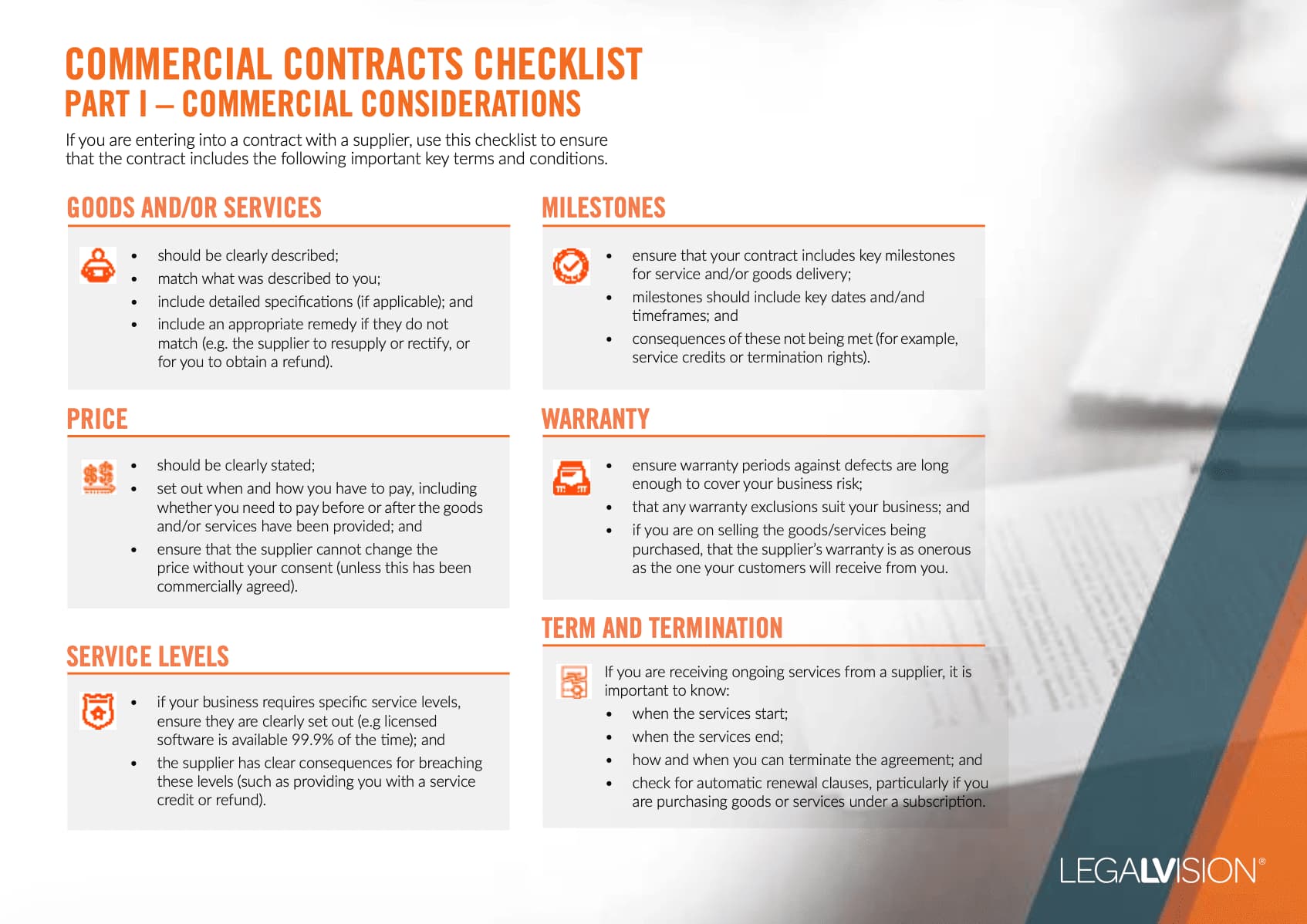
To protect your business, ensure supplier contracts meet your business’ needs. Our free Commercial Contracts Checklist will help.
Mitigation Strategies
There are various mitigation strategies that your business can utilise, including the following:
- form a specialised human team to revise AI-generated business documentation, leveraging expert oversight to identify and correct inaccuracies. This will require continuous updating and improvement to refine these documents better to suit the changing business requirements and environment. However, it is important to note that these Generative AI risks will always be present as they are not human;
- seek legal advice if the business documentation involves legal matters;
- stay updated with the evolving AI regulations and ensure legal compliance when utilising Generative-AI for business document generation;
- include proper Generative-AI use training within your company so all employees know its risks across all business units;
- conduct testing to identify vulnerabilities and weaknesses in your Generative AI; and
- if you have the means, you can also develop your own internal Generative AI software to upload and store confidential information in a secure location.
Key Takeaways
Generative AI has many benefits for businesses, but there are always unprecedented risks that need to be taken into account and considered for the long-term stability of your business. Companies need to balance leveraging AI capabilities and integrating human expertise to ensure the accuracy and reliability of their business documents.
If you need assistance with the use of Generative AI for drafting business documents, LegalVision provides ongoing legal support for businesses through our fixed-fee legal membership. Our experienced contract lawyers help businesses manage contracts, employment law, disputes, intellectual property, and more, with unlimited access to specialist lawyers for a fixed monthly fee. To learn more about LegalVision’s legal membership, call 0800 005 570 or visit our membership page.
Frequently Asked Questions
What risks do businesses face when using Generative AI for documents?
Businesses face risks, including bias, inaccuracies, and privacy breaches, when using Generative AI. The AI may generate misleading or incomplete documents because it lacks full context and legal expertise. Errors in wording, misuse of confidential data, or biased content could expose businesses to disputes or regulatory consequences.
How can businesses reduce risks with AI-generated documents?
Businesses can mitigate risks by reviewing AI-generated drafts with expert oversight, seeking legal counsel, and training staff on the safe use of AI. Companies should also monitor regulatory changes, test AI tools for weaknesses, and consider secure internal systems. Combining human judgment with AI ensures the creation of more reliable, compliant, and tailored documents.
Does New Zealand law regulate how businesses use Generative AI?
No specific law targets Generative AI directly, but existing legislation still applies. The Privacy Act 2020, Fair Trading Act 1986, and Contract and Commercial Law Act 2017 all govern how businesses collect data, communicate with consumers, and form contracts.
Can AI-generated business documents create binding contracts?
Yes, but only if they meet the legal requirements under the Contract and Commercial Law Act 2017. Always review AI-drafted agreements carefully before signing, as errors or missing terms could affect whether the contract is enforceable.
We appreciate your feedback! Request your free consultation now.






